Thursday, May 31, 2018

How infrastructure development boosts growth

0 comments
Jakarta | Wed, May 23, 2018 | 11:39 am
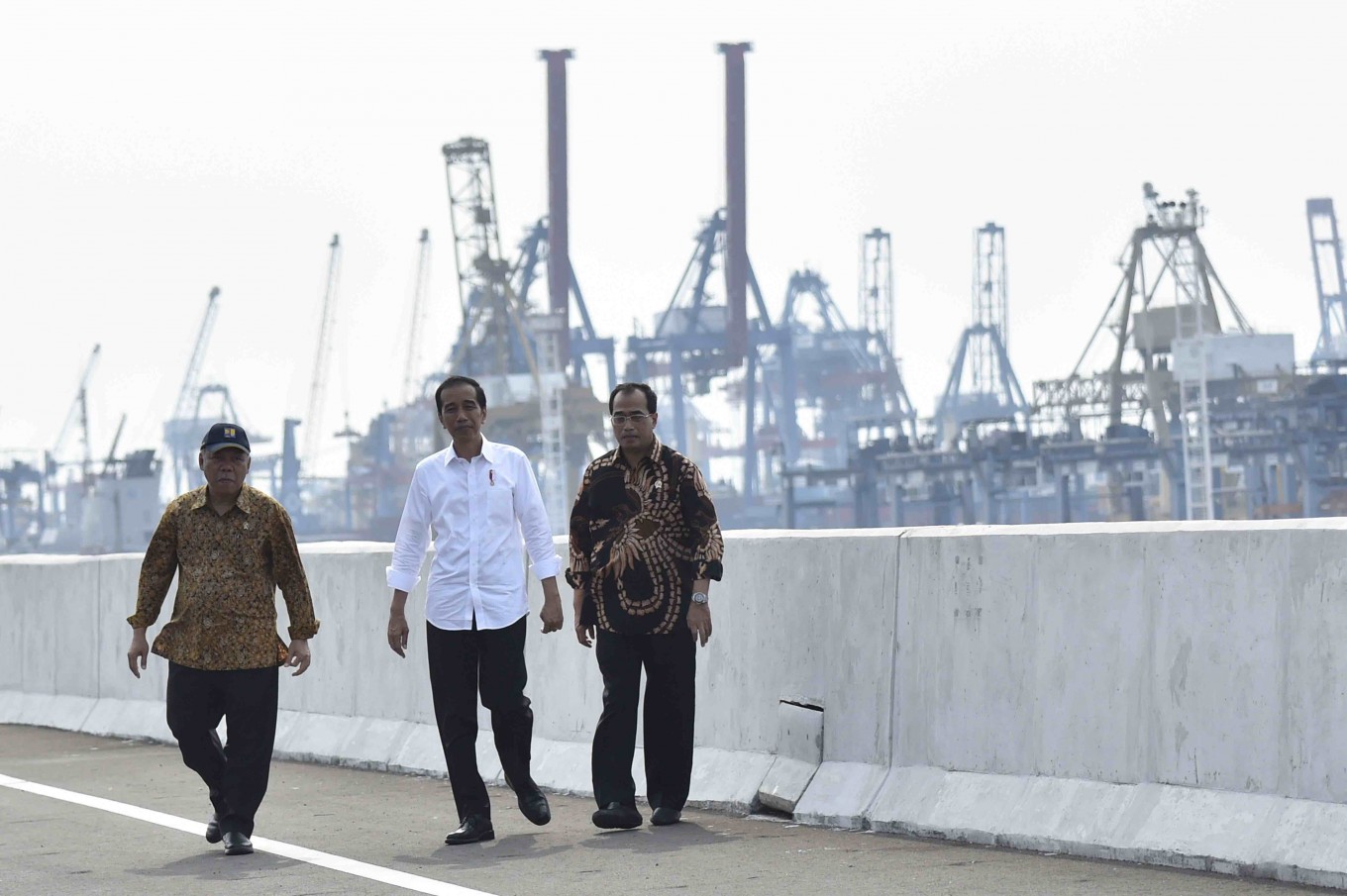
How infrastructure development boosts growthPresident Joko "Jokowi" Widodo (center), Public Works and Public Housing Minister Basuki Hadimuljono (left) and Transportation Minister Budi Karya Sumadi inspect the Tanjung Priok toll road on the day of its inauguration, April 15, 2017. (Antara/Puspa Perwitasari)

The government’s efforts over the past three years to deliver infrastructure in much more comprehensive ways have drawn acclaim for being timely and much needed. Nevertheless, some critics have painted these projects as politically motivated and a grandstanding campaign. Understandably, in view of the presidential elections scheduled for April 2019, many detractors tend to look at government policies entirely through the prism of politics, irrespective of what the objective of a government program is. 

When the administration of President Joko “Jokowi” Widodo came to power in October 2014, it released a nation-building manifesto that had nine components, aptly called Nawacita (Nine Goals). The program prioritizes a reduction of logistics costs and focuses on improved connectivity via a series of infrastructure projects involving highways, railways, seaports, airports and power generation. Nawacita also emphasizes a reduction of poverty and inequality via programs to improve education and health services and issue land titles to millions of farmers and smallholders. 

The Jokowi administration’s infrastructure program for the 2014-2019 period amounts to US$342 billion in estimated investment, including the nationwide electrification program. The billion-dollar questions are, of course, how much of this will actually be constructed and what impact will it have on the economy and reducing poverty.

A recent report published by Tusk Advisory, a regional strategic advisory firm specializing in infrastructure, answers these very questions and more. The primary authors of this report are Dr. Nicholas Morris, an Oxford-trained veteran economist, and Raj Kannan, an infrastructure delivery specialist, both experts with many years of experience working in Indonesia and the region. The other authors of the report are Luhut Sibarani and Astrid Handari.

This independent report titled “The Impact of Indonesia’s Infrastructure Delivery” catalogues all of the under-construction and completed projects since early 2015 and finds that, as of December 2017, about 286 projects were under construction or have been completed with a total combined value of $103.44 billion. These projects span energy, roads, railways, seaports, airports, water and sewerage systems and broadband cabling. The number and value of projects under construction is unprecedented, and it comes on the back of key government reforms. This report presents empirical evidence on the impact of the government’s infrastructure capital expenditure on economic growth, as well as the resulting reduction in poverty. Their econometric analysis uses a benchmark of 32 developing and emerging economies, from the World Development Indicators database of The World Bank, for the period of 1990 to 2016.

The Tusk Advisory economists describe the virtuous cycle generated by the infrastructure development: Improving connectivity between the rural and urban areas and between the major islands, reducing logistics (and thereby distribution) costs, enhancing the domestic market integration and improving the overall competitiveness of the economy, thereby attracting direct investment.

The report estimates that, as a result of the completion of current projects by the target date of 2019/2020, the country’s GDP growth rate will increase to 7.2 percent in 2023. If the government then achieves at least half of the remaining programs, another $120 billion, during the years 2020 to 2023, the report estimates that the GDP growth rate in 2030 will exceed 9 percent.

The report also forecasts that, by 2030, as a direct causation of the estimated GDP growth, the nation’s poverty rate will drop from around 11 percent now to 8 percent, thus delivering not only a much-needed boost to the economic growth of the country but also reducing poverty at the same time. The report shows that these GDP growth estimates are also consistent with growth spurts experienced by other countries in the region that had invested heavily in their infrastructure, and indeed the past experience in Indonesia during the early 90s produced similar results.

These are indeed encouraging numbers but, as highlighted in the report, the achievement of these GDP growth rates is highly dependent on the government’s ability to complete the projects that are currently under construction. It is common knowledge that this unprecedented level of infrastructure delivery has been on the back of the government assigning and relying on the strength of state-owned construction companies. Some of these construction companies are cash-strapped and — encouragingly — are exploring new avenues to continue financing these projects. 

To its credit, the government has been on the front foot to encourage and facilitate the creation of these new financing instruments, and the recent successful listing of rupiah-denominated “Komodo Bonds” at the London Stock Exchange by two Indonesian infrastructure giants stand testimony to this proactive approach. But there needs to be more concerted efforts to introduce innovative financing schemes that do not beggar the future. While these future revenue-based securities are a good start, they are indeed ultimately government debt, as the issuers are state-owned enterprises (SOEs).

This is where the private sector’s financial and managerial capabilities should be harnessed to support the country’s nation-building plans. While the SOEs are certainly capable, their capacity to continue to issue debt instruments is limited, and therefore the private sector needs to be encouraged to play its rightful role. In encouraging the private sector, the government also appears to be ahead of the curve — it is currently finalizing a regulatory framework to enable raising of fresh capital from the private sector via monetizing some of the key government assets without selling these assets and without borrowing on these assets.

These asset monetizing or asset recycling schemes are the brainchild of the Office of the Coordinating Economic Minister, and they are called Limited Concession Schemes (LCS). Under an LCS, the government will invite the private sector to compete for the expansion, operation and maintenance of selected assets for an agreed concession period of, say, 20 to 25 years. 

A good example would be Soekarno Hatta International Airport, which is expected to require more than $5 billion in capital expansion over the next 10 years to cope with ever-increasing passenger traffic. Instead of the state-owned airport operator spending this money on one airport, under the LCS, the private sector will be invited to take over the capital expansion at their cost and recoup their investments from the operating revenue of the airport during the 20-year concession period. 

Most importantly, under the LCS, the private sector will provide either upfront cash payments as concession fees to the government, which it can use to build other airports (and share with the existing airport operators) or it can agree to ongoing revenue sharing during the concession period. For Indonesia, enabling and unlocking private sector participation in infrastructure delivery is one of the key reforms needed to achieve a more lasting impact on economic growth and poverty reduction. While the government still has a long way to go to fix its funding problems, it appears the thought leaders are on the right path of harnessing not only SOEs but also the private sector.
***
The writer is a senior editor of The Jakarta Post.

 
Read full post »

Commentary: Skills are best buffer for disruptive impact of technological change

0 comments
Jakarta | Tue, May 8, 2018 | 09:04 am
Commentary: Skills are best buffer for disruptive impact of technological changeA wide variety of business models showcased at the seminars show how the application of digital technology has enabled people to enhance their lives, giving them access to education, better healthcare and other personal care services. (Shutterstock.com/INDONESIAPIX )
Technological changes and jobs are taking center stage, becoming the central theme of four out of more than two dozen seminars and meetings held on the sidelines of the 51st Asian Development Bank (ADB) Annual Meeting of the Board of Governors which ended here on Saturday.
The rationale is quite obvious. In previous industrial revolutions, technology and jobs usually had symbiotic relationships and changes were more gradual. But the latest wave of digital technology amid the fourth industrial revolution tends to be disruptive, not only causing job losses — at least — in the short term.
The searing pace of the technological changes has also swamped regulatory institutions, often catching them off guard due to difficulties in anticipating changes. But even though technologies are inherently disruptive, most panelists at the seminars shared the same views that countries with flexible policies, steady improvements in education, an economy open to foreign investors and professionals, and a stronger and broader social safety net will be able to take great benefits of the changes.
A wide variety of business models showcased at the seminars show how the application of digital technology has enabled people to enhance their lives, giving them access to education, better healthcare and other personal care services.
Yet more encouraging is that digital technology also serves to lower barriers to market entry for entrepreneurs and enable organizations of all sizes to be more efficient, innovative and increase their market reach, as well as help governments efficiently provide better public services.
Finance Minister Sri Mulyani Indrawati, a member of the ADB Board of Governors, described at one of the seminars how new service enterprises have been mushrooming in Indonesia using the digital technology as their driving force.
“Now we can have food and even massage services delivered to our homes by Go-Jek riders. This massage service could become popular during the World Bank-IMF annual meetings in Bali in October,” Sri Mulyani jokingly said, referring to Indonesia’s biggest app-based ride-hailing service.
Digital technology has enabled the Philippines to become the world’s second-largest business process outsourcing (BPO) center for companies overseas after India, employing more than 1.3 million workers with revenues of up to US$23 billion last year, almost matching the $25 billion the country received in remittances from migrant workers.
Supported by the government with the right policies, which are friendly to foreign investors and workers, and strong information and communication technology (ICT) infrastructure, the Philippine BPO industry started in the early 2000s with call service centers, then moving up to higher value-added jobs as medical transcriptions, back office operations in accounting and finance and software development.
Most of the BPO services involve repetitive tasks that are considered low-skilled in much of the developed world. However, such services are often provided by high-skilled professionals in the developing world who are attracted to the sector by higher wages.
According to the Philippine Public-Private Partnership (PPP) Center, which is responsible for preparing bankable infrastructure projects for private investors, the BPO industry now accounts for about 6 percent of the country’s gross domestic product (GDP).
An ADB report credited the remarkable achievement of the Philippine BPO industry to the establishment in 2001 of the Information Technology and e-Commerce Council (ITTEC) to serve as the country’s highest policymaking body. It provides policy direction on information and communication technology to develop the country as an e-services hub.
In 2005, the government launched the Philippine Cyberservices Corridor, an “ICT belt stretching over [965 kilometers] from Baguio City to Zamboanga”, capable of providing a variety of BPO services. It covers at least three primary urban centers in Luzon, Visayas and Mindanao, as well as 15 other provinces across the country.
For BPO investors, the key factors that can greatly affect their location decision are costs, infrastructure, human capital and governance. The expansion of the BPO industry will greatly depend on high-quality, reliable and lowcost infrastructure services.
Like in India, the explosive growth of the Philippine BPO industry has been generated by the inflow of foreign direct investments, as overseas firms started looking for low-cost locations to outsource service delivery. In fact, the first wave of growth occurred as multinational companies from the United States and Europe started establishing subsidiaries in the Philippines.
Study reports by the ADB and International Labor Organizations (ILO) presented at the seminars here concluded that due to technological advancement, more and more routine tasks are being automated or taken over by machines, and jobs are becoming more polarized.
Many jobs requiring routine tasks will be replaced by machines. In such an environment of change, skills development and human capital will play an even greater role in future economic development.
The problem though, is that Indonesia has a wide skill gap that urgently needs to be addressed, otherwise future economic development will be constrained. As the experiences of Vietnam and Thailand have shown, one way of addressing the skill gap within the short to medium term is by massively expanding vocational education.
Implementing well-resourced, well-targeted vocational training can prove to be a better long-term investment in skill acquisition that helps workers — whose prospects look to be quite bleak — cope with the difficulties they face.
Improved access to better vocational education can contribute greatly to higher income for workers and help bridge the skill mismatch. Economists have deemed skill mismatch as the cause of structural unemployment, whereby the job opportunities cannot be filled by the skills available.
Read full post »

Thursday, April 05, 2018

Commentary: Reducing inequality, cracking wealth concentration in Indonesia

0 comments
  • Vincent Lingga
Jakarta | Mon, April 2 2018 | 12:29 am
Two major meetings held here separately last week coincidentally chose poverty, economic/income inequality and their concomitant aspects as the main themes of discussion.

One was the two-day international responsible business forum on food and agriculture, opened by Coordinating Economic Affairs Minister Darmin Nasution on Tuesday, where about 400 business leaders, officials, civil society organizations and analysts from around the world discussed programs to enhance corporate-farmer partnerships to improve agricultural value chains.

The other was the launch of the World Bank’s (WB) first Indonesia Economic Quarterly report for 2018 entitled “Towards inclusive growth” featuring a keynote speech by Finance Minister Sri Mulyani Indrawati.

In the runup to the 2014 legislative and presidential elections, economic inequality and wealth concentration were a hot, major public issue and a key theme in political campaigns.

Public opinion surveys, including a very comprehensive, methodical one conducted by the WB in 2014 in cooperation with the Indonesian Survey Institute (LSI), concluded that most respondents thought inequality in Indonesia had gotten too high and that the government should act immediately to reduce it.

Likewise, in the runup to the local elections in 171 regions in June and the legislative and presidential elections in April 2019, inequality and highly concentrated asset ownership have also increasingly become hot issues.

Unsurprisingly political leaders of the opposition parties who seem so obsessed about making the current government look so bad and pathetic often resort to sweeping accusations instead of constructive policy debates.

Nevertheless, the blunt fact is that both income inequality and wealth concentration in the country have been worrisome, especially set against the painful fact that Indonesia is still one of the world’s most corrupt countries as a result of rent-seeking and corrupt behavior by many officials and politicians.

We don’t have a more recent, comprehensive survey on both issues, except the one made by the WB in 2014, published in December 2015. The public, meanwhile, could get only a glimpse of the economic inequality from Forbes magazine’s annual list of 100 hundred richest Indonesians.

The 2015 WB report essentially warned of the risks of social tension and conflict as inequality of income and asset ownership widened, recommending a more vigorous collection of taxes to broaden the taxpayer base.

Among the findings of the WB survey were that most respondents said they thought inequality was too high and they were willing to accept slower economic growth in exchange for less inequality. Furthermore, sustained economic growth in the last 15 years to 2014 had mainly benefitted the richest 20 percent and left behind the remaining 80 percent of the country’s 250 million people.

The richest 10 percent of Indonesians owned an estimated 77 percent of all the country’s wealth. In fact, the richest 1 percent owned half of all the country’s wealth, which was the second-highest level (along with Thailand) after Russia from a set of 38 countries. This meant that income from financial and physical assets benefits fewer households in Indonesia than in many other countries. The share of wealth owned by the richest 10 percent in Indonesia increased by 7 percentage points between 2007 and 2014.,in the top of 46 countries over that period.

We have become all too familiar with the main drivers of the widening inequality: Inequality of opportunity and in the labor market, massive tax evasion, high wealth concentration and unequal resilience to economic shocks.

Most analysts agree Indonesia’s narrow base of personal income taxpayers is among the main drivers of inequality, as personal income tax currently account for only around 10 percent of total tax receipts.

Worse, the structure of personal (individual) income tax is also lopsided in favor of the upper middle income and richest taxpayers as the highest rate (30 percent) is applied to annual incomes of over of Rp 500 million (US$36,500) and more, but those who earn Rp 250 million are already subject to the 25 percent tax rate.

The March, 2018 WB report therefore strongly urges the government to collect more tax revenue through an overall reform of the tax system and to spend better on priority sectors such as health, education, social assistance and rural and urban infrastructure. These measures are precisely what the Jokowi government has been doing since 2015.

More than 10 million farmers have benefitted from the easier land-titling program and millions more farmers have been given access to forest resources through the social forestry program. The rate of absolute poverty has decreased from almost 11.6 percent in 2014 to 10.12 percent, and inequality, as measured by the Gini ratio, fell from 0.42 to 0.39 and is targeted to further decline to 0.36 (0 represents perfect quality).

But these achievements seem very incremental amid the magnitude of the inequality problem because the government has been able to collect only half of the potential tax. The institutional capacity of line ministries at central government and of regional administrations is also utterly inadequate.

It is encouraging, though, that more business leaders have realized the urgent need to reduce inequality by empowering farmers not as a measure of charity but through mutually beneficial, market-driven partnership initiatives.

Franky Widjaja, chairman of the widely diversified Sinarmas group, speaking at the international responsible business forum on food and agriculture last week, reiterated the urgent need for expanding corporate-smallholder engagement.

Widjaja called for accelerated partnership arrangements between big plantation companies and smallholders so that farmers can have a better access to technical, marketing and financial assistance. He has been campaigning since 2011 for a sort of nucleus estate and smallholder (NES) scheme whereby big estates serve as the development agent providing technical and marketing assistance to improve the productivity of neighboring farmers or smallholders.

It’s high time therefore for the government to fully enforce the 2014 Plantation Law, which, among others, requires big companies to allocate a minimum 20 percent of their total plantation areas to smallholders through bank loan financing, processing and marketing cooperation arrangements.
Read full post »

Tuesday, October 24, 2017

Steel producers against imports liberalization

0 comments
  • Vincent Lingga
    The Jakarta Post

Jakarta | Mon, October 2, 2017 | 10:32 amDomestic basic steel producers have raised concerns over the government’s plan to further liberalize steel imports as part of a concerted program to improve Indonesia’s position in the World Bank’s annual The Ease of Doing Business Index which now ranks Indonesia 91st out of about 185 countries.

“Even now with import restrictions still in place, imports already control about 55 to 60 percent of our annual steel consumption of around 12 million tons, while our own steel industry operates only at 40 percent of its capacity,” says Hidayat Triseputro, the executive director of the Indonesian Iron and Steel Industry Association.

Data at the trade ministry show Indonesia is now the world’s third biggest net importer of steel and steel trade deficit last year exceeded US$6 billion, the second largest after the oil and gas trade deficits.

Hidayat expressed fear that further import liberalization would damage the national steel industry, which is still at an infant stage of development, because a good portion of the foreign steel entering the country did not meet the national quality standard (SNI). 

But an inter-ministerial team at the office of the chief economics minister in charge of preparing technical details for the 16th deregulatory package still includes basic steel among the commodities in the upcoming import liberalization measures. 

The main factor that prompted the import liberalization initiative seems to be President Joko “Jokowi” Widodo’s high ambition to upgrade Indonesia’s ranking in the World Bank Ease of Doing Business Index to 40th in 2019. 

One of the 10 parameters assessed in the World Bank survey is the efficiency of trading across borders and one of the key yardsticks to measure this efficiency is the length of dwelling time (the speed, simplicity and predictability of clearance) of containers at the seaport. Non-tariff measures (NTM) on imports and their administration have been found to slow down the clearance process of goods. 

Trade Law No. 7/2014 allows NTMs to control imports with the objective of protecting national security, the public interest, the health of the people and the sustainability of fauna and flora and the environment.

The law specifically stipulates that the government can impose NTMs to control imports of certain goods to protect domestic manufacturing industries from unfair foreign competition in order to enhance their growth and to safeguard the balance of payments at a healthy level and to protect farmers from unfair competition from foreign producers

NTMs on imports are also deemed necessary because tariff barriers are no longer effective to control imports because more than 65 percent of Indonesian imports have been derived from its free trade agreement 
partners.

Yet more important is that Indonesia is the world’s largest archipelago and its coastline is quite porous making it easy to smuggle contraband into the country or circumvent Indonesia’s trade laws.

While most businesspeople assume that Indonesia will eventually have to libelarize its market, they think this process should be gradual and selective, taking into account the development and competitiveness of domestic industries.

Moreover, according to trade ministry data, Indonesia’s position is not so bad with regards to trade protectionism: NTMs in Indonesia cover only 272 of 5,229 harmonized sysem tariffs, as against 601 in the Philippines, 313 in Malaysia, 558 in India and 1,507 in South Korea. 

But uncontrolled import flows could threaten the growth of domestic industries, erode the market competitiveness of local industrial goods and adversely affect the business climate, making investors doubt the long-term certainty and sustainability of their businesses. 

Domestic steel producers suspect that because a lot of foreign steel are often sold here at incredibly low prices, they might have entered the country illegally or circumvented import laws.

Steel executives also argue that in so far as the dwelling time at ports is concerned, the impact of NTMs on steel imports is rather negligible on the eficiency of goods flow because steel procurement or import is inherently a long process, ranging from two to four months from the time orders are made. Because production is mostly based on firm orders with specific technical and quality specifications. 

Hidayat argued that steel impor restrictions are still necessary because the national steel industry — with a total capacity of about 13 million tons, compared to 1.1 billion tons in China — is still in the infancy stage of development. Moreover, steel is seen as the mother of most downstream manufacturing industries and is strategic to the economy. 

No wonder most countries in Asia — which have suceeded in developing competitive manufacturing sectors like Japan, Souh Korea, Taiwan and China — started with the building of competitive basic steel industries.

Another reason why trade restructive measures are needed is that basic steel materials or products vary widely in quality, technical specifications and usage.

“Without restrictive measures that require thorough inspection, steel imports could easily circumvent our trading laws and quality specifications and inundate our market,” Hidayat said.

Instead of liberalizing imports, the government should help support the development of the basic steel industry through compulsory local content requirement, higher quality standards and tougher terms for new steel investment to ensure efficient and non-polluting industries.
Read full post »

NGOs, firms need constructive engagement

0 comments
  • Vincent Lingga
Jakarta | Wed, September 6 2017 | 12:54 amThe emotional outbursts of the Indonesian Palm Oil Association (GAPKI) against international environmental NGOs, though regrettably smacking of an expression of xenophobia, are the understandable explosion of frustrations over what plantation companies see as a perpetual foreign attack on palm oil, currently one of the largest foreign exchange earners in the country.

The editorial published on the GAPKI website on the 72nd independence anniversary last month, which urges the government to free palm oil from “colonial attacks” by international NGOs, reflects the industry’s wrath over what they consider to be a complete lack of appreciation for improvements already made in sustainable palm oil management over the past ten years.

Indonesian palm oil and its derivatives have been under the scrutiny of international environmentalists since the early 2000s after the widespread forest fire in 1997 and the astronomical expansion of oil palm plantations since the 1990s, which caused massive deforestation. 

Lately, several NGOs also have been campaigning to virtually coerce overseas industrial users or consumers to boycott Indonesian paper-grade pulp and dissolving pulp in a protest against the environmentally and socially irresponsible practices they allege in pulp estate management. 

Dissolving pulp for making viscose fiber fulfills Indonesia’s need for textile materials, because cotton does not grow well in the country.

Palm oil now accounts for almost 50 percent of global vegetable oil consumption and has increasingly been leading the market, as agronomists estimate its yield per hectare to be nine times as high as soybeans, five times as high as rapeseed and eight times as high as sunflowers. 

For Indonesia, now the world’s largest palm oil producer, this commodity has been developing as a very important part of the economy, since smallholders own 40 percent of the estimated 11 million hectares of oil palm plantations. Indonesia exported around 26 million tons last year, or almost half of the global palm oil trade.

We should, however, give credit where credit is due. International NGOs have campaigned tirelessly to build market (consumer) pressures to force the government, companies and farmers to implement environmentally and socially sustainable management in palm oil and forest products.

The NGOs’ global public opinion campaign has also contributed to strengthening the commitment of the government and businesspeople to legislate and enact stronger rules on high standards of sustainability.

Palm oil producers are now governed under the sustainability standards of the Indonesian Sustainable Palm Oil (ISPO) program, which is legally compulsory, and the international multi-stakeholder Roundtable on Sustainable Palm Oil (RSPO), a market-driven certification scheme. 

Palm oil and pulp producing companies, notably the big ones, have increasingly realized, again owing partly to the stringent scrutiny by NGOs, that what is bad for the environment and the surrounding communities is also bad for business.

Several years of constructive engagement have led the European Union and Indonesia to a sustainability certification scheme for wood products under the EU Forest Law Enforcement, Governance and Trade (FLEGT). This scheme audits the entire supply chain in Indonesia, from the source of timber to downstream processing, and to the point of exporting to ensure social and environmental sustainability.

Even now, international NGOs still play a role in promoting sustainable management practices of natural resources, especially in the forestry sector where the rule of law at all levels, from forest-use planning to licensing, management and law enforcement, is still inadequate.

Certainly, the achievements of the ISPO sustainability program still fall short of expectations, as the program is an ongoing process, especially because the pulp and palm oil industries involve millions of smallholders/farmers with complex poverty problems. The problem has been made even more complex by the huge gap in land registry and titling and the poor land–use planning in the country.

Now, as the NGO scrutiny has increasingly extended from environmental problems to social issues such as labor and human rights and land disputes, the solution has become even more complex and more time consuming, a process that often requires capacity building at local administrations and government institutions. 

The problem, though, is that most foreign NGOs often fail to comprehend the complexity of social conflicts and land disputes in Indonesia. They often and easily resort to a blame game against big companies if the conflicts are not resolved as quickly as they expected and mount up campaigns to boycott products. They tend to use the conditions in developed countries as their benchmark.

Attacking big companies is much easier, as they have a high profile and visibility, and many of them are listed on the Indonesian stock exchange with tough disclosure requirements. But what is actually needed is continuous and constructive, not adversarial, engagement between NGOs, the government, businesses and farmers.

Take, for example, the negative campaign on pulp producers run by several NGOs through their websites, alleging that they had grabbed the lands of the local people and deprived them of their traditional means of livelihood.

True, land disputes have mushroomed, especially since the Constitutional Court’s 2012 decision confirming that customary and communal forests are not state forests/land and must be excluded from state land concessions. 

But the claims for customary forests/land cannot always be settled quickly, because they must first be verified by the directorate general of social forestry and environmental partnership in cooperation with independent teams consisting of anthropologists, sociologists, informal leaders, legal consultants and lawyers.

For example, publicly listed PT Toba Pulp Lestari (TPL), which produces dissolving pulp in North Sumatra, received 11 claims from local communities for plots of land inside its concession. After a long process of verifying the claims, the Ministry of Environment and Forestry decided last December to approve only one of the claims covering 5,172 ha of forests and took them out of the TPL concession. 

TPL Director Mulia Nauli confirmed TPL had returned that piece of land to the state and President Jokowi ratified the status of the land as customary/communal forests on Dec. 30, 2016 in a ceremony at the State Palace. But the ministry said the remaining 10 claims had yet to be verified by the directorate general of social forestry and environmental partnership and independent teams, and so ordered the TPL to wait for the results of the verification before acting on those 10 claims. 

But several NGOs still continue to bash the TPL on their websites and social media, accusing the company of grabbing the local people’s lands and pushing industrial users to boycott TPL’s products. The government should not allow such negative campaigns with baseless accusations to damage Indonesian products in the international market. 
__________________________________

The writer is senior editor at 
The Jakarta Post.
Read full post »

Sunday, July 16, 2017

The IMF’s management of Indonesia’s crisis: A lesson

0 comments
  • Vincent Lingga
Jakarta | Mon, July 10 2017 | 12:37 amWithout a doubt former president Soeharto’s strong resistance to reforms required by the International Monetary Fund’s (IMF) rescue program should be blamed for Indonesia’s economic crisis that caused what analysts considered one of the most substantial cases of wealth destruction in modern history, as the rupiah melted from Rp 2,500 to the dollar in mid-1997 to Rp 17,500 in early 1998.

But Paul Blustein, a staff writer of the Washington Post, concluded in a book on the IMF’s crisis management that cascading errors and misjudgment by the IMF, the World Bank, the United States Treasury, the US Federal Reserve and the Asian Development Bank played no small part in worsening Indonesia’s economic crisis.

“The Indonesian crisis is a tale of error piled atop error ... by the Fund and Indonesians, with each side’s bad moves compounding the other’s and dragging the country’s economy to depths nobody had previously imagined possible,” Blustein notes in his book The Chastening: Inside the crisis that rocked the global financial system and humbled the IMF.

The IMF did have its fair share of blunders and misjudgment. For example, it told Asian countries to tighten fiscal policy during the crisis. Therefore, the credibility of the IMF, as a monetary crisis fighter, took a beating in Indonesia, South Korea, Thailand, Russia, Brazil and Turkey from 1997 to 1999.

Its biggest mistake was the drastic order for the Indonesian government to close 16 insolvent banks, including several owned by members of the Soeharto family, in November 1997. In the absence of any kind of deposit insurance program, the bank closures panicked depositors and prompted massive deposit withdrawals from most other private banks.

Despite the blunder, however, the IMF will still be called upon the instant a crisis in one country spreads to another. As imperfect as the IMF is, the world needs the economic equivalent of a fire brigade when markets plunge. In facing the big risk of financial contagion, the mere existence of a strong, active IMF can limit the transmission of crises from one country to another. 

The global financial and capital markets have become so huge, so unruly and so panic-prone that the IMF’s resources could be overwhelmed when a crisis strikes.

One of the biggest lessons from the crisis is that the IMF should strengthen its early warning system by conducting more vigorous surveys of banks and regulatory systems in countries and by providing advice on how to reduce risks and vulnerabilities.

It should be acknowledged though that the business of detecting financial crises is sometimes extremely difficult. The set of early warning indicators on high vulnerabilities like those in Thailand, South Korea, Malaysia and Indonesia seemed initially not fully reliable. In fact, most analysts observed that none of the existing early warning models anticipated the Indonesian crisis in 1998.

The crisis showed that countries need protection from panicking creditors that is somewhat similar to the kind of protection companies get under bankruptcy laws, whereby a company can ask the bankruptcy judge to call a halt to foreclose on debtors’ assets, thereby providing it with the breathing space to negotiate new and more realistic terms for repaying its debts.

A country that runs out of hard currency and defaults or declares a moratorium on all payments risks severe punishment from the financial market, or the creditors seize the country’s assets overseas.

Here the idea of a bail-in or standoff with the full support of the IMF it to give creditors adequate time to calm down and the debtor enough time to devise a sensible plan of action under the IMF’s oversight.

This is what the IMF implemented in its second rescue program in South Korea in early 1998, but under terms of a bail whereby the fiscal and monetary authorities in the United States, Britain and Japan used moral suasion to induce the foreign creditors to stop pulling their money out of the crisis-stricken country.

The rationale is that it is in the creditors’ interests to prevent a total panic, roll over their loans and accept a rescheduled payback of their claims, because a default would be avoided if all creditors participated. 

The idea is to buy time for the crisis country to resume growth, to give it a breathing space and to make sure that the creditors that are being saved from default bear a fair share of the burden involved in the rescue.

This is also called a standstill, but this solution requires a high degree of government intervention and coordination to ensure that creditors act together.

Creditors may accept the rationale that they have a collective interest in refraining from demanding immediate repayment. 

A bail-in is also good from justice point of view, because taxpayers’ funds are not used to bail out the rich, but a financial stampede is prevented, like in Korea and Brazil.

But this standstill can be effective only if the debtor countries also prevent their own citizens and foreigners from moving their money abroad. This is what Malaysia did in September 1998 by imposing capital controls. Malaysia performed well one year after following that action, despite the attack by the IMF and the US.

But the problem is how to get the IMF imprint to ensure that the debtor countries really make genuine efforts to correct their fundamental economic problems and good-faith efforts to negotiate debt repayment with their creditors.

Indonesia is now in a much stronger position to weather external shocks than in the past, thanks to the series of bold reforms taken immediately after the 1997-1998 Asian financial crisis.

“We have taken great lessons from the crisis, which cost us as much as 70 percent of our gross domestic product, as the economy contracted by 13 percent in 1998 and the rupiah melted from Rp 2,400 to the US dollar in 1997 to less than Rp 16,000,” Finance Minister Sri Mulyani Indrawati noted at the 50th Asian Development Bank annual conference in Yokohama in early May. 

She was referring to the massive fiscal, monetary and financial-sector reforms that transformed the central bank into an independent institution and introduced high budget discipline, fiscal decentralization and integrated financial oversight.
___________________________

The writer is senior editor at 
The Jakarta Post.

Read full post »
 

Copyright © Vincent Lingga - Opinion Column